


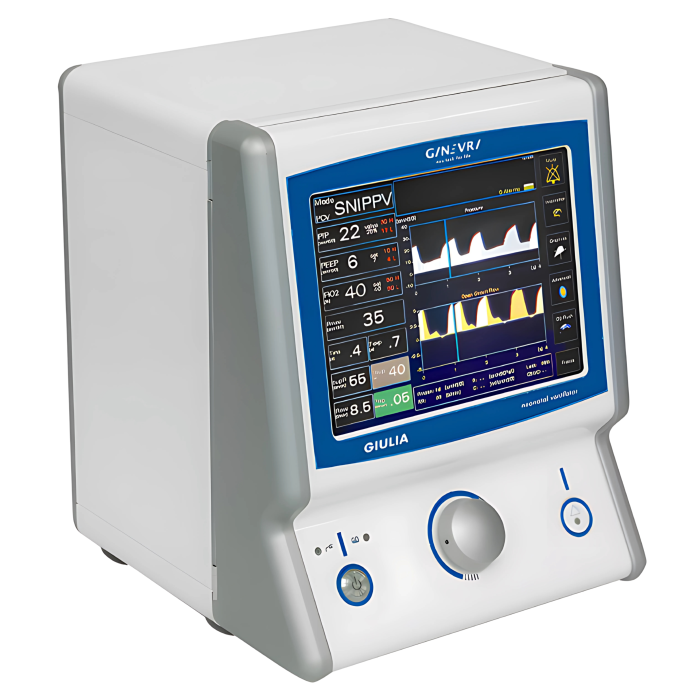
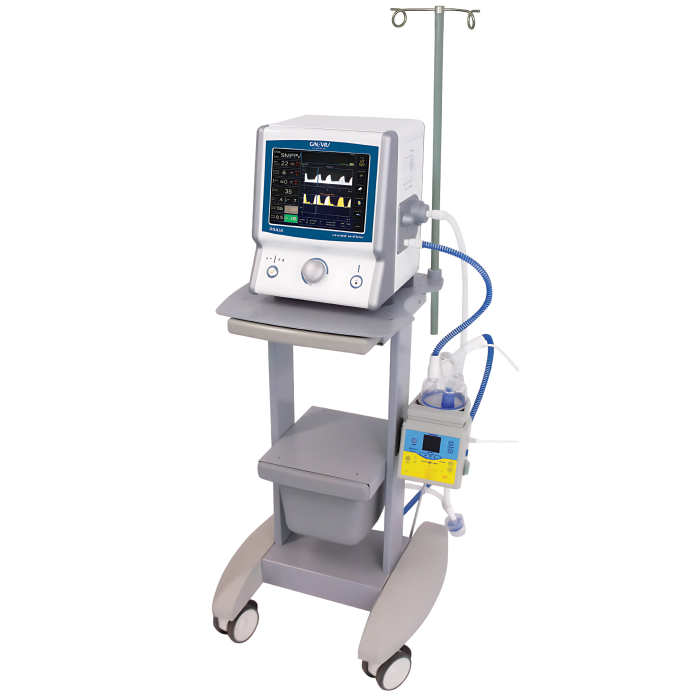
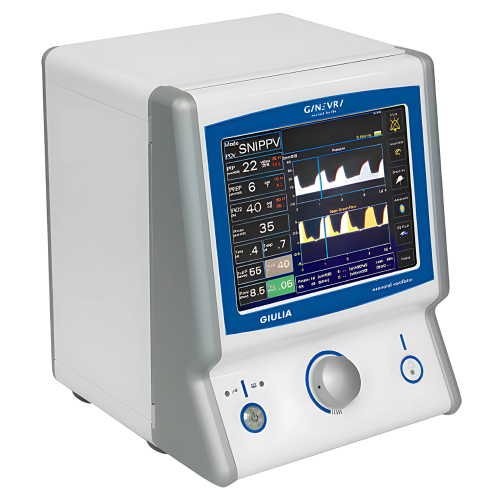
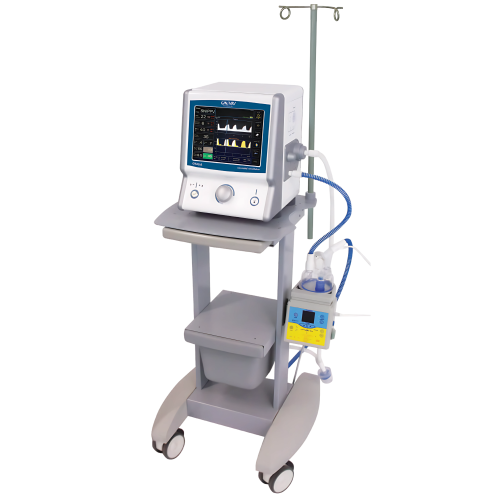
Giulia exemplifies a new generation of ventilators designed to provide the best respiratory support at every stage of the clinical management of respiratory disease in preterm and very preterm infants and newborns.
With this device, you can perform the most effective and safe modes of conventional invasive ventilation, volumetrically targeted ventilation; non-invasive methods, such as flow-synchronized nasal variable positive pressure ventilation (FLOW-SNIPPV), or the simpler high-flow heated nasal cannula (HHFNC) mode.
System
The Invasive Ventilation Flow Transmitter is a differential pressure transducer without electronic components, which in turn maximizes the response time to less than 80 milliseconds, and allows for multiple use due to autoclaving capability.
The warning system monitors the ventilator quite widely, especially: monitoring of invasive and non-invasive ventilation, the presence of visual and sound alerts to maximize the attention of the medical staff in the event of an alarm situation, the presence of a level of differentiation (3 levels) of the importance of certain alerts. Ability to control the volume and period of emergency oxygen supply.
The inspiratory flow trigger in non-invasive mode maintains a set minimum flow of 0.05 L/min, with air loss even greater than 50%. Flow Synchronized Nasal Variable Positive Pressure Ventilation (FLOW-SNIPPV) Mode Nasal variable positive pressure ventilation is a non-invasive ventilation mode that combines nasal sipap mode with intermittent mandatory breaths. The device supports both non-synchronized (non-invasive positive pressure ventilation mode) and synchronized (synchronized variable positive pressure ventilation mode) with the infant's respiratory efforts. The function of maintaining breathing, namely: at the beginning of spontaneous (spontaneous) breathing of the patient, mechanical ventilation is authorized in order to avoid damage to the respiratory system.
Functional
Ability to perform invasive and non-invasive ventilation modes;
The ventilator is suitable for pulmonary ventilation of premature infants, newborns and young children, cyclically starts with a trigger mechanism;
There is support for the accuracy of readings of flow sensors;
Two different interface models for patients;
Therapy of patients weighing up to 5 kg;
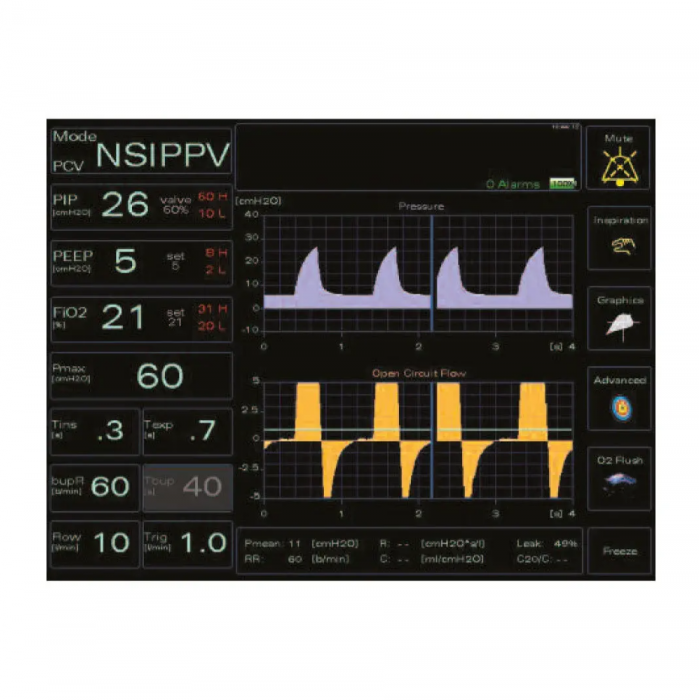
The system is equipped with a 10.4” color touch screen with digital settings;
The system is equipped with a wide range of situational alerts, both mechanical and parametric;
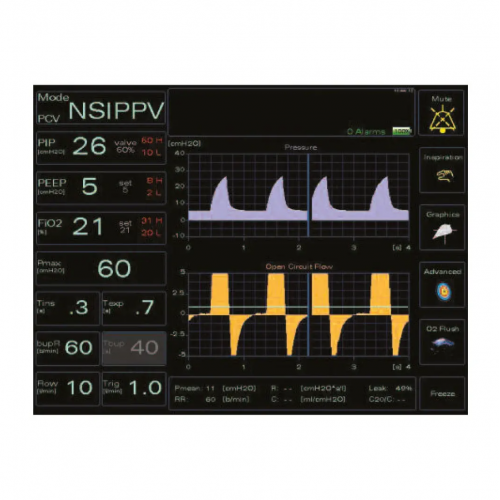
The device generates and displays graphic information of graphic pressure, flow and volume curves, as well as trend information of constant graphic;
The device measures pulmonary compliance, hardware and respiratory resistance;
The presence of an acoustic trigger activation signal;
The device supports standby mode;
There is an emergency oxygen supply button;
The instrument is functionally capable of performing the export of information;
The inspiratory flow trigger works in both invasive and non-invasive modes;
Volume Guaranteed Ventilation mode supports invasive modes with a minimum of 2ml of tidal flow;
Ability to set the support period when performing apnea mode;
When an error or breakdown occurs, the notification system displays a letter of these errors for further resolution;
The system is equipped with an oxygen mixer.
Ventilation modes
The system is designed to perform the following non-invasive ventilation modes:
NCPAP (constant airway pressure nasal mode);
NIPPV (nasal variable positive pressure mode);
NSIPPV (Nasal Synchronized Positive Pressure Variable Ventilation);
NSIMV (Nasal Synchronized Intermittent Mandatory Ventilation).
Reviews
0/ 5
average product rating
There are no reviews for this product. Be the first to leave your review.
